L16 / Exam 1 practice & review
Exam 1 Practice
Practice the first-exam topics with the current lecture's worked problem sequence.
01 / UNDERSTAND & PREDICT
Understand the model, then predict the result
Follow the original explanations, diagrams, derivations, and examples in slide order, then use the companion experiment below.
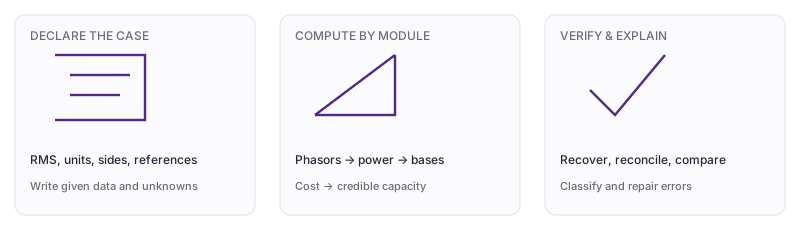
- Write given data, references, and unknowns before choosing the method.
- Check physical units, sequence, power sign, and transformer side.
- Reproduce intermediate values in Python, then submit independent fixed-case answers.
Phasors and conjugation
L16 example 1: V=180∠−20° V, I=12∠+10° A with current entering the positive terminal. Δφ=−30° means leading current and negative load Q.
Delta-load reference
L16 example 2 uses ZΔ=8+j6 Ω, VAB=208∠0° V and abc. Set source VAN to −30° before deriving branch and line currents. This differs from other examples using VAN=0°.
Single-phase transformer bases
L16 example 5A uses Sb=30 kVA, Vb,H=1500 V, Vb,L=150 V and ZH=1.50+j3.4369 Ω. Single-phase Ib=Sb/Vb and Zb=Vb²/Sb. Referral to LV must retain zpu.
Capacity and economics
L16 example 6 uses GT fixed/variable costs 75000 and 85, and CC 195000 and 45. A separate capacity case has 160 MW peak, 15% reserve, and full capacity credit.
Stepwise checks
Check RMS versus peak, line versus branch, single- versus three-phase bases, and source versus receiving end. Then use recovery, power accounting, or equivalent transforms. Return to the relevant module after an error.
Baseline example: check each step
- Example 1: P≈1870.615 W, Q=−1080 var, pf≈0.866 leading.
- Example 2: IAB=20.8∠−36.870° A and IA≈36.027∠−66.870° A.
- Example 2: P=10383.36 W and Q=7787.52 var; ZY=(8+j6)/3 Ω checks equivalence.
- Example 5A: Ib,H=20 A, Ib,L=200 A, zpu≈0.020000+j0.045825 on both sides.
- Example 6: crossover 3000 h/year; at 2000 h GT=245000 and CC=285000 $/MW-year; required capacity=184 MW.
Cross-check the original slides
02 / EXPLORE
Change one input and explain the response
Complete the seven numbers, then use a base scan to check physical invariance. Classify errors as phasor, three-phase, equipment, or planning and revisit that module.
Advanced parameters / test readings
Preparing the model.
Switch review plots by topic
Current intermediate values and numerical checks
Fixed practice uses original L16 examples 1, 2, 5A, and 6 separately from variable experiments. Three-phase bank connections are extensions and are not added to this Exam-1 check.
03 / EDIT & COMPUTE
Edit code to reproduce the model independently
Reproduce the baseline, then modify the parameter scan. The source contains reusable independent model functions; edit the current function and inspect numerical checks.
case is a snapshot of the controls when you press Run. Call solve(case) and assign the final solution to result to plot it.
The first run needs internet access to download Python. Computation stays in your browser; the solver uses only the standard library.
Ready to run.
Output appears here.
Last Python run and current control reference
Inspect and edit the model source (advanced)
Edit this module's function and run again. case.module selects the module; solve(case) returns values, plots, and checks. The parameter experiment keeps the original JavaScript reference for comparison.
04 / CHECK & EXPLAIN
Companion experiment practice and feedback
Use the fixed original L16 data above: V=180∠−20°, I=12∠10°; Δ branch 8+j6 Ω, VAB=208∠0°; single-phase Sb=30 kVA, VH=1500 V, ZH=1.5+j3.4369 Ω; planning peak 160 MW, PRM 15%.
Practice uses fixed baseline inputs independently of the controls. Each field displays its tolerance.
See the worked solution
- Example 1: P≈1870.615 W, Q=−1080 var, pf≈0.866 leading.
- Example 2: IAB=20.8∠−36.870° A and IA≈36.027∠−66.870° A.
- Example 2: P=10383.36 W and Q=7787.52 var; ZY=(8+j6)/3 Ω checks equivalence.
- Example 5A: Ib,H=20 A, Ib,L=200 A, zpu≈0.020000+j0.045825 on both sides.
- Example 6: crossover 3000 h/year; at 2000 h GT=245000 and CC=285000 $/MW-year; required capacity=184 MW.
Finally, explain in your own words
- What are the inputs, references, and main assumptions?
- Complete the seven numbers, then use a base scan to check physical invariance. Classify errors as phasor, three-phase, equipment, or planning and revisit that module.
- Did your code edit change physical parameters, the method, or representation bases? Which check helps identify that?
Passing numerical and understanding checks records this lecture’s companion practice as “practice checks passed.”