三相功率与平衡核查✓ 配套练习已通过
01 / UNDERSTAND & PREDICT
理解模型,再预测结果
按原课件的页序阅读讲解、图示、推导与例题,再使用本讲下方的配套实验。
 L09 · 1 / 44
本页文字
正在载入本页文字。
图形与页序来自本讲学生版 PDF。
线电压 400 V,三个相同阻抗均为 20+j15 Ω。把负荷从 Y 改为 Δ,线电流是原来的 √3 倍还是 3 倍?
- 区分相电压/线电压与支路电流/线电流。
- 用相量相减与节点电流关系检验 √3 和 30°。
- 核对三相功率和理想平衡时的零中性电流。
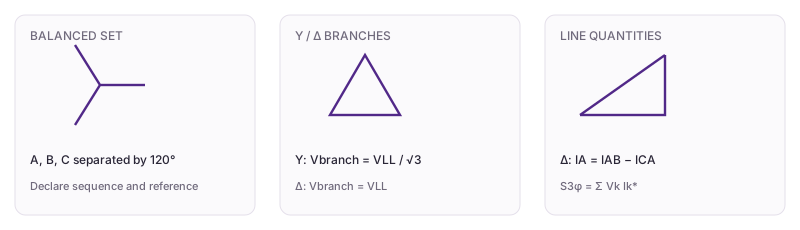 平台绘制的概念路径;数值实验在下一节。
相序与参考
本模块以虚拟电源中性点的 VAN=V相∠0° 为参考;abc 相序使 B、C 分别为 −120°、+120°。改变相序改变相角关系,而不改变平衡负荷总功率。
三相功率
S_{3\phi}=\sum_k\mathbf V_k\mathbf I_k^*,\quad |S|=\sqrt3 V_{LL}I_{line}
用三个相电压与对应线电流的共轭求和,或用支路功率求和。平衡正弦三相的瞬时总功率为常数;每相瞬时功率仍有振荡。
基准例题:一步一步核对
- Y:V支路 = 400/√3 ≈ 230.940 V。
- I支路=I线≈9.238 A;负载角 atan2(15,20)≈36.870°。
- P=5120 W,Q=3840 var,|S|=6400 VA。
- Δ 且同支路阻抗:I支路=16 A,I线≈27.713 A,P=15360 W。
本讲原始 slide 标题39
- 1Lecture outline
- 2Identify the source, line, and load first
- 3Start with a balanced Y–Y network
- 4Extract one phase, then reconstruct three
- 5A Y source feeding a Δ load
- 6Compare Y and Δ at the same terminals
- 7Derive the balanced impedance relation
- 8Use the balanced Δ↔Y conversion
- 9Start from the Y–Y diagram: one-phase power
- 10Sum the three Y-connected load branches
- 11Change the load connection: Y versus Δ
- 12Derive both phase and line forms
- 13Three-phase power: phase and line forms
- 14From load power to feeder power balance
- 15Why line power uses |I_A|^2
- 16Source, line, and load power balance
- 17Example: complex power of one delta leg
- 18Example: power of the 13.8-kV delta
- 19Example A: 480-V wye feeder
- 20Example A: per-phase circuit
- 21Example A: solve the phase current
- 22Example A: line voltage drop
- 23Example A: load phase voltage and KVL
- 24Example A: load line-to-line voltage
- 25Example A: load complex power
- 26Example A: complete power balance
- 27Example A: independent checks
- 28Example B: 4.16-kV delta feeder
- 29Example B: delta-to-wye load conversion
- 30Example B: source reference and phase circuit
- 31Example B: solve the line current
- 32Example B: load voltage and KVL
- 33Example B: load terminal line voltage
- 34Example B: physical delta branch currents
- 35Example B: source complex power
- 36Example B: line and load absorption
- 37Example B: source, line, and load powers
- 38Example B: independent reconstruction checks
- 39A complete balanced three-phase solution
对照原始 slides
02 / EXPLORE
改一个输入,解释一个变化
将接线切成 Δ,再把阻抗各分量乘 3,验证线电流和总功率恢复到原 Y 的结果。切换相序后检查 VAB 相角。
展开进阶参数 / 试验读数
正在准备模型。
负荷支路电压—
支路电流—
线电流—
总有功—
总无功—
平衡电流和—
三相相电压
三相线电流
当前中间量与数值核查
模型为理想平衡三相源、三个相同负荷阻抗和零线路阻抗。图中的电源中性点是相位参考;Δ 负荷没有中性导体。
03 / EDIT & COMPUTE
修改代码,独立重现模型
先复现基准输入,再修改参数扫描。模型源码包含可复用的独立计算函数;可以编辑当前函数,利用核查项判断改动的影响。
case 是点击运行时的参数快照。调用 solve(case),将最终解赋给 result,即可绘制代码结果。
首次运行需联网下载 Python 环境。计算在浏览器内完成,求解器只用 Python 标准库。
准备运行。
输出将在这里显示。
上次 Python 运行与当前滑块参考
查看并编辑模型源码(进阶)
编辑当前模块的计算函数后再次运行。case.module 选择模块,solve(case) 返回数值、图形与核查项。参数实验使用原始 JavaScript 参考,便于比较。
04 / CHECK & EXPLAIN
配套实验练习与反馈
固定练习数据VLL=400 V RMS,正 abc 相序,Y 负荷每支路 Z=20+j15 Ω,VAN 相角为 0°。
练习采用固定基准输入,不随上方控件改变。各项容差显示在输入下方。
查看分步解答
- Y:V支路 = 400/√3 ≈ 230.940 V。
- I支路=I线≈9.238 A;负载角 atan2(15,20)≈36.870°。
- P=5120 W,Q=3840 var,|S|=6400 VA。
- Δ 且同支路阻抗:I支路=16 A,I线≈27.713 A,P=15360 W。
最后,用自己的话解释
- 这个模型的输入、参考和主要假设是什么?
- 将接线切成 Δ,再把阻抗各分量乘 3,验证线电流和总功率恢复到原 Y 的结果。切换相序后检查 VAB 相角。
- 你的代码修改改变了物理参数、计算方法,还是表示基准?哪个核查项能帮助判断?
完成数值与理解检查后,本讲配套练习会记录为“练习检查通过”。